Showing posts with label By Lee Ching Ching. Show all posts

Wednesday, 15 March 2017

Audit Evidence

What is Audit Evidence? First of all, Audit Evidence is the evidence that obtained during the financial audit. They used by the auditor in arriving at the conclusions on which the auditor's opinion is based.

Therefore, they are consists both information that supports and corroborates management 's assertions regarding the financial statements or internal control over the financial reporting and information that contradicts such assertions.

However, they included types of audit evidences such as, inquiries of the client, documentation, analytical review procedure.Firstly, documentation is the examination the client's supported the documents. Only support internal and external documents. Secondly, inquiries of the client for this standard they only oral or written the information from the client they will do the confirmation by others sources.Thirdly, is the analytical review procedure is to comparisons of the recorded amounts to establish the industry average and make the auditor's understanding.

In addition, the audit evidence they also include 7 type of regular role such as:


  • Relevance - must pertain the audit objective being tested
  • Independence - evidence form outside the client is a stronger form of evidence
  • Effectiveness of client internal controls - good internal controls can mean better information
  • Auditor direct knowledge - auditor determinations are stronger that client comments
  • Qualifications - individual is a qualified source
  • Degree of objectivity - objective evidence is stronger than subjective evidence
  • Timeliness- balance sheet account evidence is better when it collected around the date of the financial statement, income statement evidence should sample entire period.
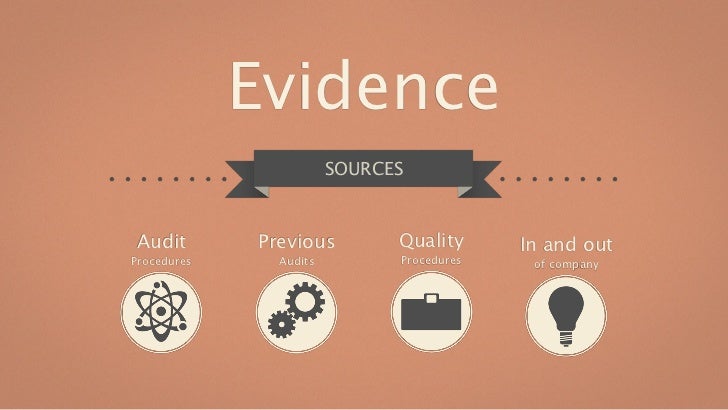
Image result for audit evidence
The sources of evidence

References:
https://pcaobus.org/Standards/Auditing/pages/auditing_standard_15.aspx
http://www.investopedia.com/terms/a/auditing-evidence.asp
https://www.slideshare.net/osamarizvi/9-audit-evidence


                                                  The video of Definition Audit Evidence 


Thursday, 9 March 2017

Understanding Of Auditing

What is an audit? Auditing is usually conducted by an independent agency to conduct an official check of an organization's account. Therefore, it is not possible to audit each fraud case. Conduct official financial checks on the company or its account.

In fact, auditing them is a fair examination, they will always evaluate an organization's financial statements. It can be done internally, such as an organization's employees or an external company. Thus, auditing refers to an organization's systematic examination of books, accounts, documents and vouchers to determine the financial statements on the concerns of the real and fair views.

The meaning of auditing, is an accountant who conduct an audit they must verify the accuracy of the financial report and accounting practices of the business and government. They are officer duty and examine the accounts, received the money from public. For example, shareholders and check the all records transactions of the management. 


Furthermore, the purpose of audits is to specialize the types of audits based on the audit purpose. For example, to verify the compliance, conformance or performance. By the way, some audit they also have special administrative purpose. Such as, auditing documents, risk or performance or following up the completed corrective actions.

In others situation, in internal audit they also have included some regular role that internal audit responsible. For example, evaluating the relevant risk factors associated with the key activities, analyzing operations and confirming information, working closely with line managers to review operations and report findings or reviewing the compliance and due with the diligence procedures, evaluating the report and effectiveness the efficiency of the implementation of management policies, evaluating the internal controls and advising the managers at all levels.These all will be responsible by internal audit.

Besides that, the internal audit will ensures that the organization is adhering to the rules, regulations, laws, standards, codes of ethics, guidelines and principles apply, individually and collectively, to all parts of the organization. 


In addition, they are also include financial audits objectives such as:


  • Ascertain the validity and reliability of information
  • Provide an assessment of a system's of internal control
  • Express an opinion about a person, organization or system under evaluation


References:
https://www.skillsportal.co.za/content/introduction-auditing
https://www.slideshare.net/shub-singhania/gaurav-mida-3238
http://www.a-countingbiz.com/auditing-explained/
http://asq.org/learn-about-quality/auditing/